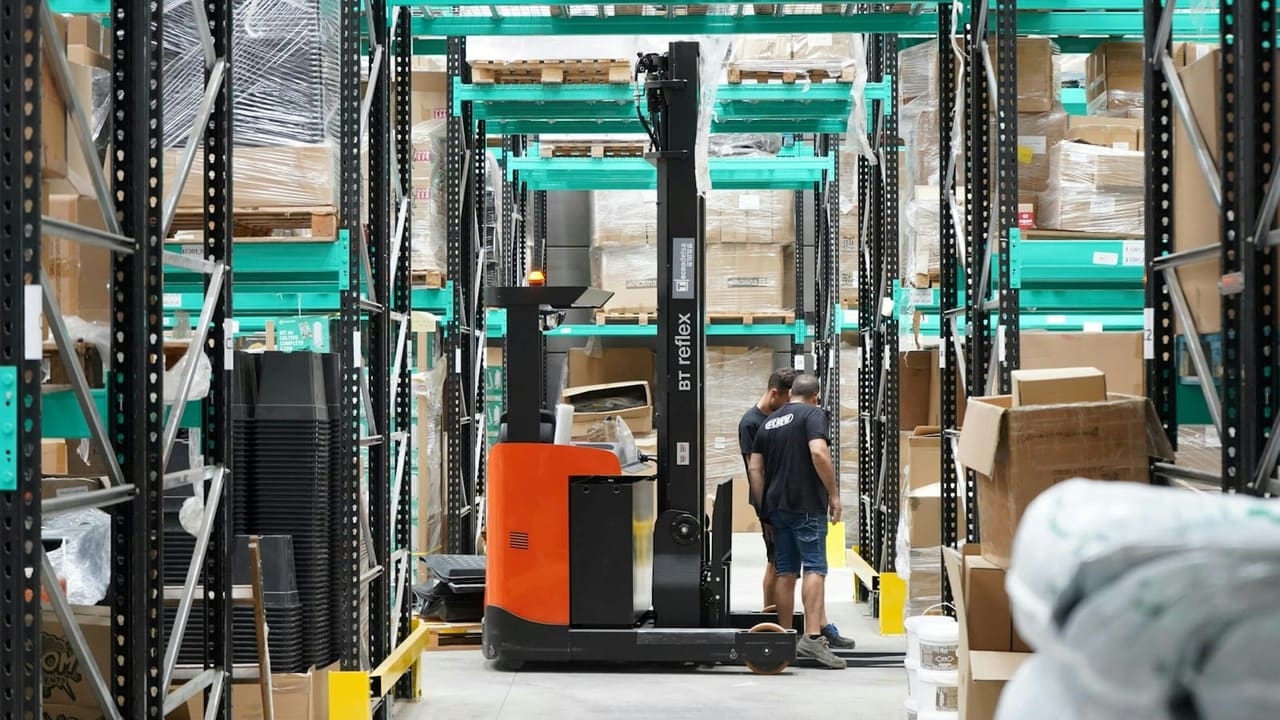
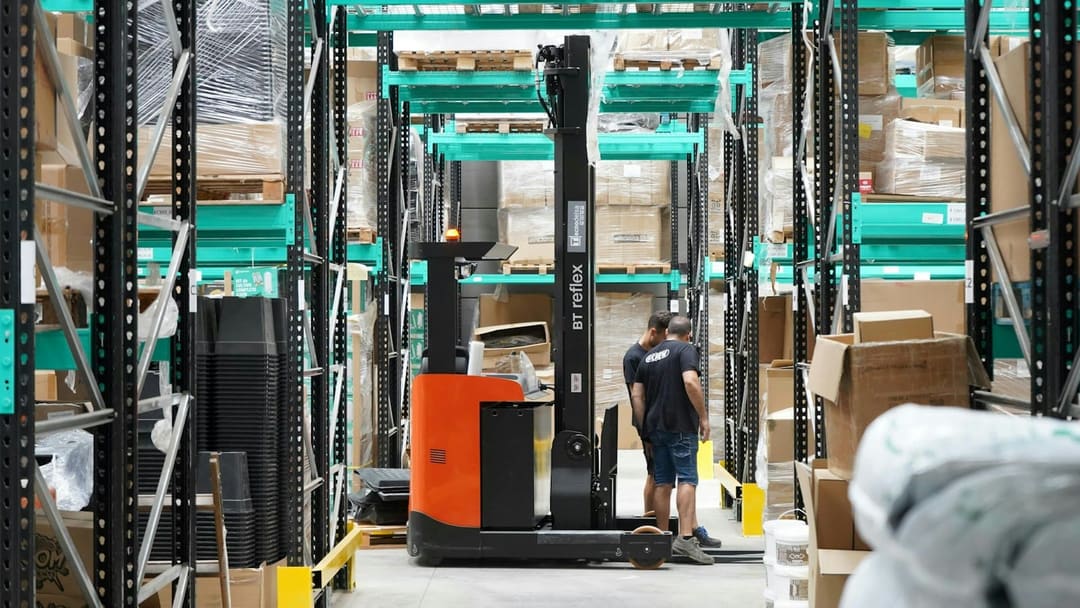
A WMS digitises warehouse operations end to end: receiving, put-away, picking and dispatch.
Key takeaways
- A WMS records every movement in the warehouse, from receiving to dispatch, down to the location level.
- Barcode or RFID scanning markedly reduces the risk of errors compared with manual records.
- The picking strategy (single order, batch, zone, wave) should match your order profile.
- ERP answers "how much stock do we have?", WMS answers "where exactly is it?"; the two work together.
In this article7 sections
Tracking warehouse stock only as "how many units do we have" stops being enough as order volume grows. Not knowing which shelf a product sits on stretches picking times and leads to wrong shipments and count discrepancies. A warehouse management system (WMS) solves this by tracking every movement inside the warehouse down to the location. This article explains what a WMS is, its core functions, how it differs from ERP and what to watch for in a WMS project.
What is a WMS?
A WMS (Warehouse Management System) is software that runs the whole warehouse operation: receiving goods, putting them away on shelves, picking them for orders, packing and dispatching. Warehouse staff usually work with handheld terminals or mobile devices, scanning barcodes; with each scan the system records in real time which product, in what quantity, entered or left which location.
Core WMS processes
- Receiving: incoming goods are scanned against the purchase order or delivery note; missing, surplus or damaged items are recorded.
- Put-away: the system suggests a suitable location based on product type, volume and how often it moves.
- Location management: the warehouse is addressed by aisle, rack, level and bin, so the position of every item is known precisely.
- Picking: orders are turned into tasks that send the picker along the shortest route.
- Packing and dispatch: picked items are verified one last time, packed and labelled through the carrier integration.
- Counting: cycle counts check specific locations regularly without shutting the warehouse down.
Picking strategies
Picking is the most labour-intensive part of warehouse work, so the right strategy makes a big difference.
- Single-order picking: each order is picked separately; simple and clear for low-volume warehouses.
- Batch picking: several orders are picked in one trip and sorted afterwards; it cuts walking distance in e-commerce warehouses with many small orders.
- Zone picking: each worker is responsible for one area; efficient in large warehouses.
- Wave picking: orders are grouped into time windows based on criteria such as carrier pickup times.
Having the system enforce FEFO (first expired, first out) for products with expiry dates and FIFO (first in, first out) for others, together with lot and serial number tracking, also provides traceability when a recall happens.
WMS versus ERP
The two are often confused, but they answer different questions and usually work together.
| Topic | ERP | WMS |
|---|---|---|
| Focus | The whole business: finance, sales, purchasing, production | The physical operation inside the warehouse |
| Stock information | Total quantity per warehouse | Detail by location, lot and serial number |
| Users | Office teams | Warehouse staff, handheld terminals |
| Key question | "How much stock do we have and what is it worth?" | "Where exactly is the stock and how is it moving?" |
In a typical setup, orders flow into the WMS from the ERP or the online store, the WMS manages picking and dispatch, and completed movements are reported back to the ERP.
Benefits of a WMS
- Inventory accuracy: every movement is recorded by a scan, so the stock in the system matches the stock on the shelf.
- Fewer wrong shipments: the wrong item or quantity is caught at scanning, before packing.
- Faster order fulfilment: optimised picking routes shorten walking distances.
- Easier onboarding: the system guides workers step by step, so new staff do not have to memorise the layout.
- Measurable performance: picking times, error rates and productivity are tracked with data.
The real value of a WMS is that it frees the warehouse from depending on people's memory and turns it into a system where everyone works from the same accurate information.
What to watch for in a WMS project
For a smooth transition, settle the warehouse's physical layout and location addressing scheme before the software. Products need barcodes, and handheld terminals and wireless coverage must be adequate across the warehouse. ERP, e-commerce and carrier integrations should be planned from day one, and an opening stock count right before go-live makes sure the system starts with correct inventory.
Conclusion
A WMS is the most effective way to make warehouse operations visible, measurable and error-free, and it removes the bottlenecks that hold back businesses with growing order volumes. At Dijicrea we begin warehouse projects by studying the workflow on the floor together with the client, then build the system around how the warehouse really operates, from handheld terminal screens to ERP and carrier integrations.