Project overview
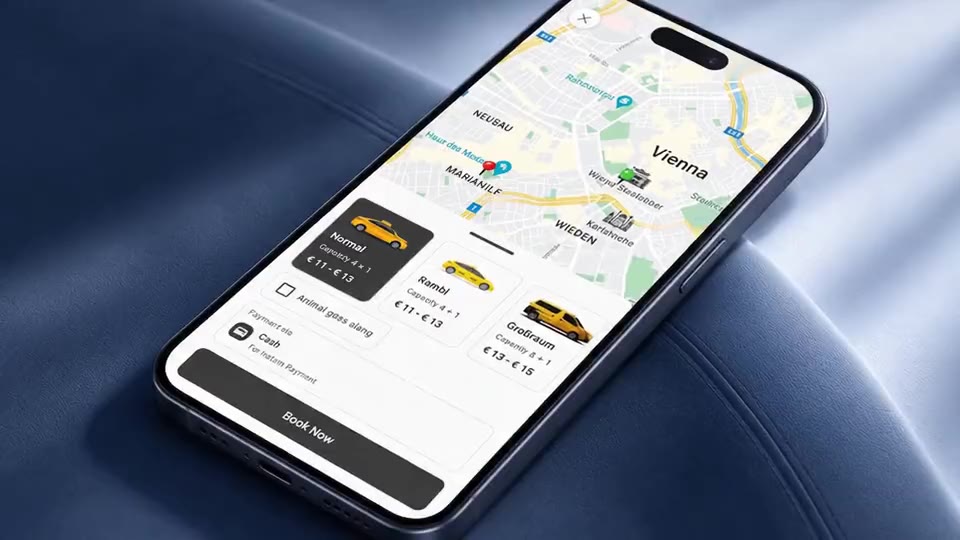
Fast, reliable city transport depends on hailing a taxi being easy and transparent. EOS Taxi was designed as a mobile app that lets passengers in Vienna book a taxi directly from a map.
What we built
- Map-based booking: a booking flow where pick-up and drop-off points are chosen on the map.
- Ride tracking: following the car's position and the status of the ride after booking.
- User account: quick access to past rides and saved addresses.
- Driver screens: the flow where drivers accept requests and manage the ride.
- Fare information: an estimated fare before the ride and a summary at the end.
- Multilingual interface: language support suited to an international city.
We placed the map at the centre of the experience and arranged every other control around it for comfortable one-handed use. Since the app is used in an international city, the interface relies on short labels and clear icons.
How we worked
We began EOS Taxi with a short discovery: together we pinned down the target user, the main flows and the scope of the first release. We then designed the flows and interface in Figma and tested them with a clickable prototype. Throughout development we shared working builds at regular intervals, and we prepared the app for release after testing it on real devices.
Technical foundation
We built the app for iOS and Android from a single Flutter codebase, using Swift and Kotlin where platform-specific needs arose. On the server side there is an API written in Node.js, with Firebase for push notifications and authentication. Design and prototypes were prepared in Figma.
Outcome
EOS Taxi became a mobile app that turns booking a taxi in Vienna into a clear, trackable experience that takes only a few taps.
Technologies used
- Node.js
- Flutter
- Swift
- Kotlin
- Firebase
- Figma